What Is The Fatality Rate Of Whitewater Rafting In Costa Rica?
An honest look at why no official rafting fatality statistic exists for Costa Rica, what the national safety norms require of operators, and what to check on a Sarapiqui rafting listing before booking.
The question sounds morbid, but it is the most responsible question a rafting researcher can ask. People who type "what is the fatality rate of whitewater rafting" into a search box are usually not looking for gore. They are trying to decide whether to hand over a credit card, and whether to bring their teenager. Fear of the answer, not curiosity, drives the query. This site publishes a catalogue of Sarapiqui rafting trips, so it has a direct interest in an honest reply rather than a reassuring one.
The honest reply is that no official rafting-specific fatality figure for Costa Rica was found. Searches across the tourism board, the national emergency agency and the park service turn up no published statistic that isolates commercial rafting deaths. That absence is itself the finding, and it is worth explaining carefully, because a missing number can be read two ways: as evidence that nothing bad ever happens, or as evidence that nobody is counting. The truth sits closer to the second, with important caveats.
No official rafting-specific fatality statistic for Costa Rica was found in searches of the tourism board, the national emergency agency and the conservation areas system. General aquatic accident deaths are tracked nationally, but commercial rafting is not isolated as a category, so any single percentage number quoted online for Costa Rica rafting should be treated as unsupported.
That answer frustrates people who want a number to weigh against, say, driving a rental car. It should. A rate needs a numerator (deaths in commercial rafting) and a denominator (total commercial rafting participants), and neither is published as a dedicated series by the Costa Rican authorities whose remit would cover it. What does exist is a different kind of evidence: a detailed national technical norm that tells operators exactly who may paddle which class of rapid, what equipment must be issued, and what certification a guide must hold. That regulatory structure is the closest thing to a safety answer the country offers, and it is a strong one.
The gap is not unique to Costa Rica. Rafting-specific incident statistics are rare worldwide, partly because the activity sits across several regulatory seams: tourism, sport, transport and civil protection. The Costa Rica Red Cross tracks drownings and aquatic accidents in general, but its figures mix rivers, beaches and pools, and do not separate guided commercial trips from private swims. A first page of search results will sometimes present a confident percentage anyway. Treat those with suspicion unless the source names an official dataset, because we could not locate one.
What a reader can do with the missing number is substitute verifiable facts: the norms below, the operator's own cancellation and equipment record, and the listing's stated minimum age and group size. If a trip is run under certified guides, issues helmets and life jackets to every paddler, and cancels in high water, the residual risk is being managed by people whose job is exactly that. The rest of this article walks through each of those checks.
The three trips above span the difficulty range this site sells: the Class III-IV extreme run that is the most reviewed listing in the catalogue at 5.0 from 845 reviews, a Class II-III afternoon trip from La Fortuna rated 4.8 from 39 reviews, and a gentle jungle safari float rated 5.0 from 23 reviews. Difficulty choices are the biggest safety lever a reader personally controls, which is why the comparison matters more than a statistic nobody publishes.
What The National Rafting Norms Require Of Operators
Costa Rica norm INTE G60-1:2019 sets minimum participant ages by rapid class, requires operators to supply and verify helmets and life jackets for every participant, and a companion norm INTE G60-2:2019 requires guides to hold national certification in rafting and swiftwater rescue with current first aid and CPR.
The age table in the national rafting technical norm is unusually specific. Under 5 years: no rapids at all. Ages 5 to 7: Class I and II only. Ages 8 to 11: Class I to III. Ages 12 to 17: Class I to IV. Ages 18 and over: Class I to V. Class VI is never open to commercial participants. In plain terms, a Class III-IV Sarapiqui trip is legally open from age 12, and a Class II-III family float from age 8, but operators frequently set their own higher minimums, and the listing's stated age always governs the booking.
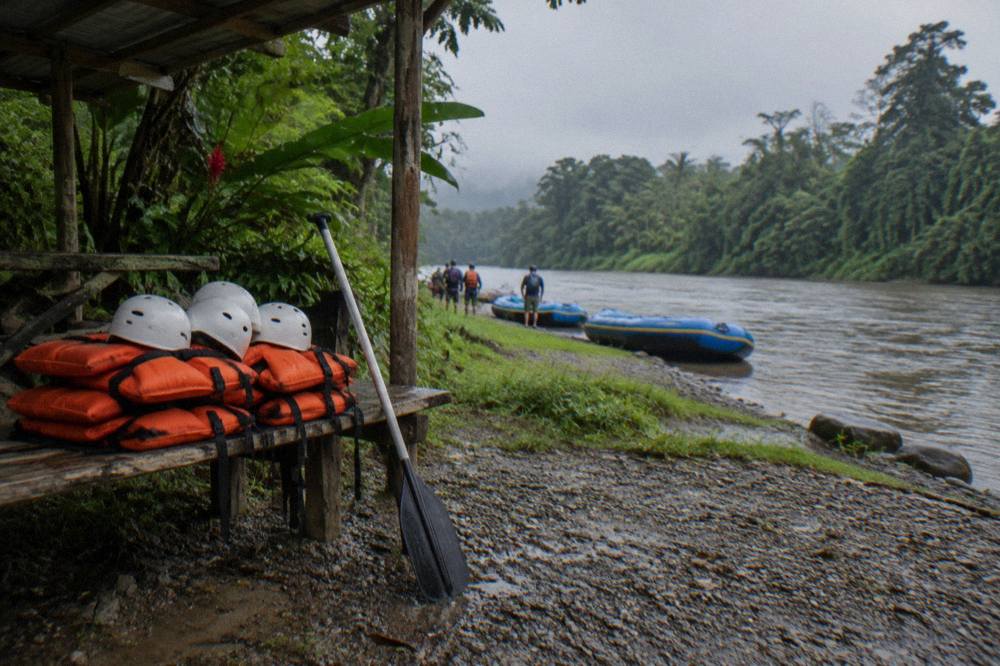
Equipment duties are explicit in the same document. The operator, not the customer, must provide and verify helmets meeting national or international rafting standards and personal flotation devices with specified buoyancy, including a stated 22 pounds of buoyancy for Class III and above. When a Sarapiqui listing says "all safety equipment" is included, that phrase is not marketing padding; it is the operator discharging a written obligation. Guests should still check the fit themselves and say something if a jacket is loose.
Guide qualification is covered by a second norm. INTE G60-2:2019 requires rafting guides to hold national certification in rafting and swiftwater rescue, to keep first aid and CPR current, and to meet minimum age and compliance requirements. On top of that, the adventure tourism regulation (Decreto 39703-S-TUR and its updates) requires adventure operators to use ICT-credentialed or ICT-approved guides. A certified guide on a Costa Rican river has been trained for the specific failure modes of the job: swimmers in fast water, flipped rafts, foot entrapment.
These norms also explain why an honest article about safety should push readers toward listed, bookable trips rather than informal arrangements. A licensed operator cancelling a departure because the river is too high is complying with a risk management framework, not being timid. The adventure tourism regulation folds insurance and risk management duties into operator compliance, and the rafting norm requires operators to brief participants on technique before the trip. Everything a norm demands happens upstream of the customer's decision, which is why the checks in this article focus on what a listing reveals.
Why Nobody Publishes A Rafting Death Statistic
Costa Rica tracks general aquatic accident deaths through the Red Cross, but those figures cover rivers, beaches and pools together and do not isolate commercial rafting, so a rafting-specific rate cannot be computed from published data, and no 2025 or 2026 rafting incident figure from official sources was identified.
There is a structural reason for the silence. Rafting deaths are rare enough, and administratively scattered enough, that no single agency owns a count. The tourism board licenses and promotes; the emergency agency responds to events; the conservation agency manages protected land; the Red Cross compiles aquatic accident data that predates adventure tourism categories. A death on a commercial river trip could plausibly land in several ledgers, none of which is designed to answer the question a nervous booker asks.
The absence cuts both ways, and this site will not pretend otherwise. It means nobody can quote you a reassuringly low rate with an official source behind it, and it equally means nobody can quote you an alarming one. Anyone online who states "the fatality rate for Costa Rica rafting is X percent" without naming an official dataset is filling the vacuum with invention. The verification work behind this article found no such dataset, and saying so plainly is more useful than a fabricated decimal.
What regulated markets do instead of a rate is mandate prevention: age floors by rapid class, equipment standards, guide certification, and operator duties to inform participants of restrictions. Health disclosures fall in the same basket. The national norm requires operators to inform participants of conditions that rule out rafting, and operators commonly list pregnancy, certain cardiovascular conditions, low mobility and obesity as restrictions or non-recommended categories. If any of those apply to someone in your group, the listing or a direct question to the operator settles it before the river does.
For readers who want the broader statistical picture rather than the rafting-specific one, the honest pointer is to the general aquatic accident reporting of the Costa Rica Red Cross, with the clear caveat that it does not separate guided trips. And in any emergency anywhere in the country, the nationwide number is 911.
How Operators Manage Risk On The Sarapiqui Day To Day
Risk management on the Sarapiqui happens mainly through water-level judgment: the river is rain-fed and undammed, operators report Class II-III conditions in the drier months and up to Class III-IV after heavy rain, and trips are cancelled or rerouted in high water, flooding or road closures rather than run regardless.
That last clause deserves emphasis because it is the operational fact behind every safety question. A river with no dam responds to rainfall within hours. The same section can present as a friendly Class II-III float in February and as a pushy Class IV corridor after a week of October storms. Operators who work the river daily read that change the way pilots read weather, and the correct commercial response to dangerous levels is to cancel or move the trip, not to tough it out. Green season flooding in the Sarapiqui lowlands is a documented pattern, with evacuations and road closures in some wet months, and any honest operator plans around it.
Equipment and briefing routines sit on top of that judgment. Every roster listing on this site includes safety equipment (helmet, life jacket, paddle) in its inclusions, which mirrors the national norm's requirements rather than exceeding them. Before the water, guides run a safety talk covering paddle commands, what to do if you fall in, and how to hold the raft line. Several Sarapiqui listings also carry a safety kayaker, an extra paddler who shadows the raft to collect swimmers quickly. Your clothing choices matter too, since the wrong outfit can undo what a helmet and life jacket provide, and our guide to the wardrobe mistakes that ruin a rafting day explains exactly what to leave on shore.
The rain numbers explain the seasonal pattern. The Sarapiqui lowlands average about 3,464 mm of rain per year based on 1990 to 2020 data, with November the wettest month at roughly 445 mm across about 17 rainy days and April the driest at about 117 mm across about 8 rainy days. Daytime air sits around 28 to 30 C year-round. Higher water generally means bigger waves and stronger currents, which is why operators describe the green season, May to November, as the time rapids step up in class, and the dry season, December to April, as the more predictable family window. More detail is in the site's Sarapiqui river levels and rapid class by season guide.
Difficulty selection is where a reader's own risk decision actually lives. The roster spans three tiers, and the differences are concrete.
| Trip type on this site | Example listing | Rapid class | Listed duration | Minimum age |
|---|---|---|---|---|
| Family rafting | Family Rafting Class II-III, Meal (La Virgen departure) | Class II-III | 3 hours | 6 per listing |
| Extreme run | Extreme White Water Adventure Class III & IV (La Virgen departure) | Class III-IV | 3 hours | 14 per listing |
| Wildlife float | Jungle Safari Float from La Fortuna | Gentle float, no whitewater claim | 6 hours | Check the listing |
A first-timer who wants whitewater without the top tier can also consider the afternoon Class II-III trip from La Fortuna, rated 4.8 from 39 reviews at from $92.66 per person with lunch included, or the Class IV trip from La Fortuna that leads this article, at 5.0 from 845 reviews, from $85 per person, with hotel transport for hotels within about 6 km of the operator's main office. Both listings state free cancellation, which matters for a nervous booker: weather and nerve both change, and a refundable booking absorbs that.
What To Check On A Listing Before You Book
Before booking any rafting trip, verify five things on the listing itself: the stated minimum age against your group, whether safety equipment and a certified guide are listed as included, the cancellation policy, the departure point and pickup terms, and the rapid class the trip actually runs, remembering that a rain-fed river can raise the class on the day. Once you've confirmed those listing details, our guide to Costa Rica's rafting safety rules explains how certified guides, required gear, and age minimums vary by rapid class so you can judge whether an operator truly meets the standard.
The first check is the cheapest safety instrument available. The national norm sets the legal age floor by rapid class, but the listing's minimum governs the booking, and operators choose higher floors for good reasons: group dynamics, paddling strength, the specific section they run. This site's rafting age and weight limits guide covers the full table; the short version is that ages 8 to 11 may legally paddle Class I to III, and ages 12 to 17 may legally paddle Class I to IV, with several Sarapiqui listings setting their own minimums of 6, 7, 8, 12, 13, 14 or 15 depending on the trip.
| Check | What good looks like | Red flag |
|---|---|---|
| Minimum age | Stated plainly on the listing, at or above the norm for the class | No age stated, or an age below the legal floor for the class |
| Equipment | Helmet and life jacket listed as included, per the norm | Gear "available" or rented at the meeting point |
| Guide | Certified or professional guides stated in inclusions | No guide qualification mentioned anywhere |
| Cancellation | Free cancellation stated, with terms | Strict no-refund terms on a weather-dependent trip |
| Water conditions policy | Operator states trips may be cancelled or rerouted in high water | No mention of water levels at all |
Pickup and departure details tell you how the day is structured, and they vary more than newcomers expect. Some listings meet you at an operator base in La Virgen and van you to the river; others include hotel pickup from La Fortuna or San Jose. The listing states which; never assume. If a listing says pickup is excluded, plan the drive yourself, and in green season check road conditions on the route you will use, because Route 32 through Braulio Carrillo is repeatedly affected by rainy-season landslides and drivers commonly divert via alternates. The site's how to get to La Virgen de Sarapiqui guide covers the approaches.
Group size is the final soft signal. Roster listings state caps such as up to 15, 24, 25, 30, 36, 42 or 50 guests depending on the trip, and a smaller cap generally means more guide attention per raft. It is not a safety rating on its own, but combined with the checks above it rounds out the picture. Weight limits, kid pricing and medical policies are operator-specific everywhere: check the listing rather than any general article, including this one.
Should A Beginner Worry About Class III-IV Rapids?
A beginner should respect Class III-IV water rather than fear it blindly: the class demands continuous paddling and the ability to follow commands in bigger waves, the national norm treats it as an adult-and-teen tier from age 12, and several Sarapiqui listings set even higher minimums, so the honest test is fitness and willingness, not nerve alone.
The distinction matters because "beginner" hides two different people. One is a reasonably fit adult who has never held a paddle but can swim, listen and exert for a sustained spell; that person routinely runs Class III-IV guided sections in Costa Rica and reports loving them, which is exactly why the most reviewed listing on this site, the Class IV trip from La Fortuna with 845 reviews at 5.0, is booked heavily by first-timers. The other is a nervous non-swimmer or someone with a listed medical restriction; for that person the Class II-III family trips or the wildlife floats are the right tier, and choosing them is the smart call, not the timid one.
Guides also compress the learning curve deliberately. The safety briefing, the paddle commands practiced on flat water, and the guide's positioning through each rapid exist precisely so that a first-timer's job reduces to: paddle when told, hold on when told, and stay in the boat. The system is designed for people who have never done it before. What it is not designed for is someone who hides a health condition or cannot swim; the norms require disclosure for good reason.
If the difficulty question is what brought you here, read the site's first time rafting in Costa Rica guide and the rapids classes explained breakdown before booking anything. The short guidance from this article: pick the tier that matches your weakest paddler, not your boldest one. Sarapiqui River Rafting sells trips across the whole range for exactly that reason, and swapping a nervous sibling from the Class IV run to the safari float costs less than a bad memory.
What The Missing Number Should Change About Your Decision
Treat the absent fatality statistic as a prompt to verify the controllable things: a listed trip run under certified guides, with issued helmets and life jackets, a stated minimum age, free cancellation, and a willingness to stand down in high water, addresses nearly every risk factor a published rate would have summarized.
This is the practical takeaway of the whole article. A number would have let you compare rafting against skiing or scuba on a chart. Its absence means the comparison has to happen at the level of the specific operator and the specific day, which is honestly where it belongs anyway. Two trips on the same river in the same week can differ more than two rivers differ in a season, because water, guide and group composition all move.
The verified facts about the regulatory floor are the strongest reassurance available: age tiers written into a national technical norm, mandatory helmets and life jackets with specified buoyancy, guides certified in rafting and swiftwater rescue with current first aid and CPR, and an adventure tourism regulation requiring ICT-credentialed personnel. No amount of marketing copy improves on that structure, and any operator operating inside it has already absorbed most of the risk a solo statistic would measure.
Then book with an exit. Every listing in this site's roster states free cancellation, and green season plans in particular deserve that flexibility, since heavy rain can close roads and raise rivers on short notice. Pair the booking with a quick look at the seasonal picture, keep your own health disclosures honest, and the question this article opened with resolves into a better one: not "what is the rate," but "is this trip, this week, the right tier for my group." That question has a verifiable answer.
Common Questions About Rafting Safety In Costa Rica
What Is The Fatality Rate Of Whitewater Rafting?
No official rafting-specific fatality rate for Costa Rica was found in searches of the tourism board, the emergency agency and the park service. General aquatic accident deaths are tracked but do not isolate commercial rafting, so any specific percentage quoted online without an official dataset should be treated as unsupported.
Is white water rafting in Costa Rica regulated?
Yes. National technical norm INTE G60-1:2019 sets minimum participant ages by rapid class and requires operators to supply and verify helmets and life jackets for every participant. Guide certification in rafting and swiftwater rescue with current first aid and CPR is required under INTE G60-2:2019, and the adventure tourism regulation requires ICT-credentialed guides.
What is the minimum age for Class III-IV rapids?
The national norm allows ages 12 to 17 to paddle Class I to IV, so 12 is the legal floor for a Class III-IV trip. Individual operators often set higher minimums, with Sarapiqui listings stating ages of 12, 13, 14 or 15 depending on the trip. Always check the listing.
Do rafting trips get cancelled for high water?
Yes. The Sarapiqui is rain-fed and undammed, so levels rise quickly with rainfall, and operators cancel or reroute trips during high water events, flooding or road closures rather than running them regardless. Green season months carry the highest chance of this.
Can beginners do Class IV rapids in Costa Rica?
Many fit first-timers do run guided Class III-IV sections, and the most reviewed Class IV trip on this site holds 5.0 from 845 reviews largely on beginner bookings. The honest test is swimming ability, fitness and willingness to paddle hard; nervous non-swimmers belong on Class II-III trips or wildlife floats instead.
What safety equipment must an operator provide?
Helmets meeting national or international rafting standards and personal flotation devices with specified buoyancy, including 22 pounds for Class III and above, are mandatory under the national norm and must be supplied and verified by the operator for every participant.